
June 9, 2026
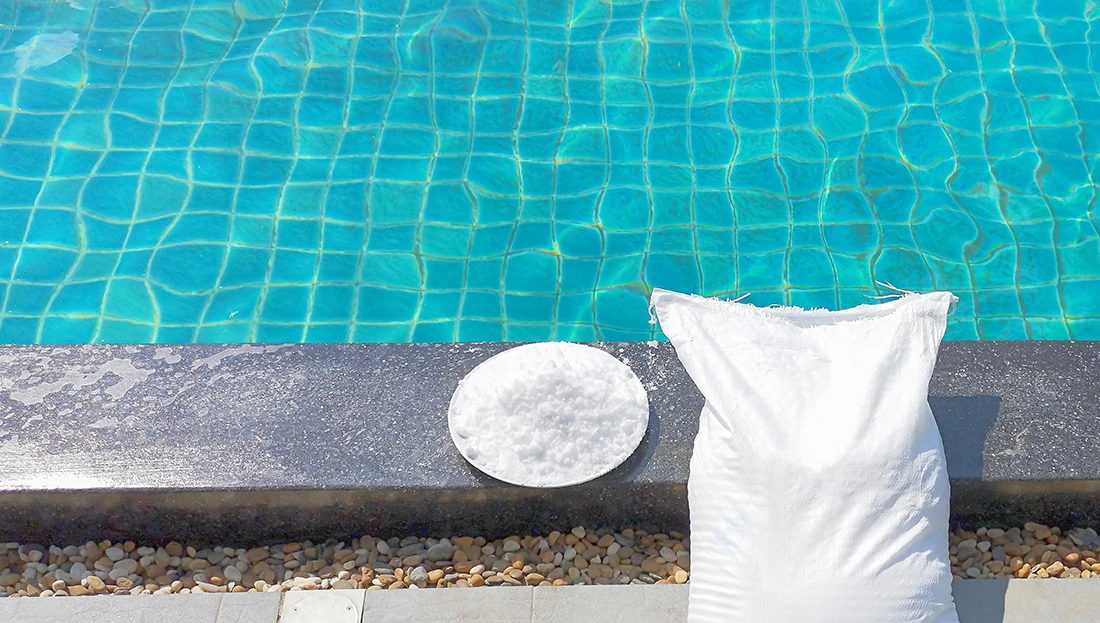
Saltwater vs chlorine pool in Florida is one of the most common questions we hear from homeowners in Boca Raton, Wellington, and Stuart. The honest answer is that both work beautifully in Florida — they just suit different people, budgets, and locations. Let’s compare them the way we’d explain it standing in your backyard, without steering you toward whatever’s easiest for us to sell.
First, a myth worth retiring: a saltwater pool is not a “chlorine-free” pool. A salt system generates chlorine continuously from dissolved salt — it simply automates a job you’d otherwise do by hand. So this is really a choice between two ways of delivering the same sanitizer.
Saltwater vs chlorine pool costs in Florida (2026)
The upfront difference is smaller than most people expect. A salt water pool installation typically adds roughly $1,800 to $4,500 for the chlorine-generating system at build time, while a traditional chlorine setup runs about $2,000 to $4,000 for equipment. Where they diverge is over the years.
- Monthly chemistry: about $75–$120 for saltwater vs. $60–$90 for chlorine.
- Salt cell replacement: $800–$2,100 every 3–7 years — closer to 3–4 years for homes near the coast, 5–7 inland.
- 10-year cost of ownership: roughly $11,800–$17,200 for saltwater vs. $7,200–$10,800 for chlorine, including the cell.
So saltwater costs more over a decade — but the gap is modest relative to the day-to-day quality-of-life difference for many owners.
Maintenance and feel
Saltwater’s biggest draw is the experience: softer-feeling water that’s gentler on skin, eyes, and swimsuits, and far less hands-on chemical handling — no hauling and storing chlorine tablets. The trade-off is that the system still needs professional attention; “saltwater” is not “maintenance-free,” and the cell needs periodic cleaning and eventual replacement. Chlorine pools demand more frequent monitoring and manual dosing, but they recover faster from a sudden algae bloom or a pool-party spike — a real advantage in our heat.
The Florida-specific considerations that actually matter
This is where local knowledge changes the answer. In our 85–95°F summers, a salt system tends to hold a more stable chlorine residual than manual dosing, which is a genuine plus for mid-size and larger pools in Wellington or Palm City. But two Florida realities push the other way.
- Coastal corrosion. Homes within about half a mile of the ocean — think parts of Jupiter, Hobe Sound, and coastal Fort Lauderdale — already battle salt-air corrosion. Adding a salt pool can compound wear on nearby metal fixtures, railings, and equipment unless materials are selected carefully.
- Pool size. For small plunge or dip pools under about 8,000 gallons, chlorine is often the more sensible, lower-cost choice.
| Our honest recommendation For most mid-size or larger South Florida pools located more than half a mile from the ocean, saltwater is the better long-term value — the water feels better and the chemistry is steadier through summer. Closer to the coast, in very small pools, or on a tight budget, a well-managed chlorine pool is the smarter call. There is no universally better system — only the one that fits your home, and we’ll tell you which we’d choose for your specific lot. |
Key takeaways
- Saltwater pools still use chlorine — they just generate it automatically from salt.
- Saltwater costs a bit more over 10 years (~$11.8k–$17.2k vs. ~$7.2k–$10.8k) but offers softer water and less chemical handling.
- Coastal homes and very small pools often favor chlorine; mid-to-large inland pools favor saltwater.
- Either way, material selection matters in salt-air South Florida — plan for corrosion resistance.
What to Look for in a South Florida Pool Builder
Search “custom pool builders near me” and you’ll be buried in the same three words: award-winning. And look — a beautiful, award-worthy pool is a wonderful thing, and we’re proud of the ones we build. But here’s the uncomfortable truth no trophy tells you: awards measure how a pool photographs on its best day. They say nothing about whether your project will be managed competently, finished on time, or honored after the final payment clears. Check out our process.
You’re not hiring a photographer. You’re handing a company six figures and three to six months of access to your home. So vet them like it. Here’s how.
1. Verify the license — yourself, in two minutes
In Florida, pool construction is regulated by the Construction Industry Licensing Board under the Department of Business and Professional Regulation (DBPR). You can and should verify any builder’s license yourself at MyFloridaLicense.com. Confirm the license is active, in the company’s name, and is the right type — a residential or commercial pool/spa contractor, not a general handyman’s registration. Unlicensed work can be reported to the DBPR hotline at 866-532-1440.
2. Confirm real insurance and workers’ comp
Ask for a certificate of insurance — general liability and workers’ compensation — and confirm it’s current. This isn’t paperwork theater: if an uninsured crew member is hurt in your Palm City or Parkland backyard, you do not want that liability landing on your homeowner’s policy. A legitimate builder hands this over without hesitation.
3. Look for FSPA membership
Membership in the Florida Swimming Pool Association (FSPA) is a meaningful signal. FSPA membership requires proof of insurance, workers’ compensation, and active certifications, and you can check a company in the Find a Pool Pro directory at https://fspa.com/pool-pros. It’s not a legal requirement — which is exactly why the builders who maintain it tend to be the ones who take the profession seriously.
4. Ask the questions that actually predict your experience
Licensing and insurance are the table stakes — the price of being considered at all. What separates a smooth build from a nightmare is project management, and you can surface it with a few direct questions:
- Who manages my project day to day? Get a name and a role. The owner stays involved is not an answer. Who picks up when there’s a problem on a Tuesday afternoon?
- How will I get updates, and how often? A real process — a portal, a weekly check-in, a shared schedule — beats we’ll call you when there’s news.
- What’s your timeline, and what’s the difference between a promise and an estimate? A trustworthy builder explains what could move the date and how they’ll communicate when it does.
- Can I talk to a customer from a year ago — not last month? Anyone can produce a happy client right after handover. The real test is who’s still satisfied after a full year and a warranty season.
- How are change orders and warranty issues handled? Clear, written processes here prevent the most common disputes.
| Where Craft Master stands We’ll happily show you beautiful pools. But what we’d rather be judged on is this: every Craft Master project has a named person managing it day to day, a real cadence of updates so you’re never wondering what’s happening in your own backyard, and honest timelines stated as what they are. Awards are nice. Being the builder who actually answers the phone in month four — that’s the job. |
Key takeaways
Ask who manages your project day to day and how you’ll get updates — those answers predict your experience more than any award.
Verify any builder’s license yourself at MyFloridaLicense.com — active, correct type, correct name.
Require current general liability and workers’ comp certificates before signing.
Check FSPA membership at FloridaPoolPro.com as a credibility signal.